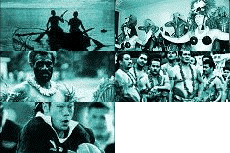
The Republic
of Kiribati straddles the equator in the central Pacific and is made
up of 33 islands - Banaba, the large island - and 32 atolls spread over
three archipelagos Gilbert, Phoenix and Line.
Spanish
explorer Pedro Fernandez de Quiros sighted the northern Kiribati island
of Butaritari in 1606. In 1788 British naval captains John Marshall
and Thomas
Gilbert, for whom the Gilbert Islands were later named, found other
islands while sailing from Australia to China. The islands were visited
regularly by whalers and traders who eventually deserted their ships
and settled on the islands. Many black birders also came to the islands
and forced islanders into slavery on their ships or on plantations in
other parts of the world. Many did not give in without a struggle though.
The Kiribati people were known as fighters and used spears with shark
teeth on them in battle.
After
the arrival of Christianity in the mid-1800s, sixteen of the islands
were declared a British protectorate along with nine of the Polynesian
inhabited Ellice Islands (now Tuvalu). The discovery of phosphate on
Banaba (or Ocean Island as it was called) resulted in it being placed
under British jurisdiction as well. In 1916 Britain formally annexed
the area as the Gilbert and Ellice Islands Colony.
During WWII the Gilbert Islands were
occupied by Japan and became
…MORE |
|
|
 |
| |
Letele, Roshni, Sham, Teleiai Su’a
Edwin, Ruta & Olo Elise on arrival at Faleolo Airport. |
|
|
|
|
|
|
|
|
|
|
|
|