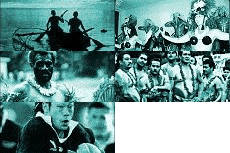
New Caledonia
was named by explorer, Captain James Cook in 1774. The mountainous islands
reminded him of his homeland in the Scottish highlands - Caledonia being
the Roman name for Scotland. In 1853, Napoleon III made moves to annex
the territory to set up a prison and in 1860 it became an official French
colony.
The main
island Grande Terre is cigar shaped and is home to 60% of New Caledonia's
population. The outlying islands are the Isle of Pines, Mare, Lifou,
Ouvea and Isles Bilep. Noumea, the capital, is based near the southern
tip of Grande Terre and blends refined comfort with a choice of high-energy
activities. In this small centre there are more than 130 restaurants
and plenty of nightlife.
Further
north, Hienghene beckons with high mountains that plunge dramatically
down to the ocean. Lagoons, valleys, beautiful waterfalls, a cultural
centre and Melanesian villages are excellent tourist attractions South
of Grande Terre lies the Isle of Pines. Many early explorers were impressed
with the pine-studded beaches that remain unspoilt today. An 18th century
French prison site on the island provides a strong contrast to the island's
otherwise post-card perfection. Then there is the island of Ouvea. Here
you'll find the ultimate beach at Fayaoue - 25 km of powder-fine sand
and nothing else in sight except coconut
trees
…MORE |
|
|
 |
| |
Letele, Roshni, Sham, Teleiai Su’a
Edwin, Ruta & Olo Elise on arrival at Faleolo Airport. |
|
|
|
|
|
|
|
|
|
|
|
|