|
ABOUT
NIUE:
It's just
a pinprick on the Pacific map, and yet despite its size (259 km squared)
Niue has acquired a long list of nicknames - Rock of Polynesia, the Island
on its Own, Island of Secrets, Wild Island - and more infamously, Savage
Island.
Explorer
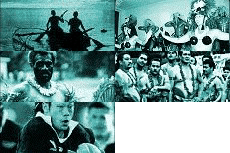
Captain James Cook who tried to land there three times in 1774 coined
the latter name. Upon arrival he was greeted by the terrible vision
of what he thought were savage cannibals fresh from a grisly meal. In
reality, his 'welcoming' party had blackened their faces with ashes
and painted their teeth red with berry juice to ward off the newcomers.
Today
most Niueans laugh at the term 'Savage Islanders'. Such survival tactics
were necessary they say, against enemy marauders and slave traders.
Not only was Niue subjected to Samoan and then Tongan rule in pre-European
times, but they were also the target of South American slave traders
in the mid-1800s.
Survival
tactics of a different kind are being employed by Niueans today. With
a sparse population of around 1800, Niue is now engaging in a war to
lure foreigners.
Tourism provides much needed money for the small economy, and as many
tourists are finding out, the country is not a hard proposition to sell.
Niue is
an elevated atoll and one of the largest coral islands in the world.
The main island's coasts are surrounded by several small coral islands
that rise sheer and jagged above the ocean.
Its impressive
and massive structure has a limestone base with two terraces rising
from the sea. The lower terrace rises sharply creating the 20 metre
cliffs that virtually surround the island. The upper terrace rises abruptly
from this coastal belt to a central plateau some 60 metres above sea
level.
Movement
of the earth's plate under the island has caused the spectacular caves
and crevices that are Niue's greatest natural draw cards. Stalactites
and stalagmites give a mystical quality to the caves.
Throughout
the island, the multiple varieties of orchids, frangipani and bougainvillea
light up the deep forest green with their colourful bouquets. Butterflies
abound and there are large forests to explore containing rich bird life.
Niue is
the smallest self-governing state in the world. In 1901 Niue was annexed
to New Zealand and later gained internal self-government in 1974. New
Zealand meanwhile oversees Niue's foreign affairs and defence. Most
Niueans immigrate to New Zealand where they enjoy dual citizenship,
to seek better employment and education opportunities.
December
to March are the hurricane months. The cool season runs from April to
November. A good time to visit the island is around 19 October when
they celebrate Niue's constitution. Running for up to five days, activities
include traditional cultural performances, parades and sports. Another
festivity during this time is Peniamina Day that marks the birth of
Christianity on the island.
|