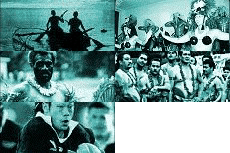
Papua New Guinea has 600 offshore islands including New Britain, New Ireland
and Bougainville. Portuguese Papua New Guinea is based on the eastern
half of New Guinea. An independent state, it shares its location with
the Indonesian territory of Irian Jaya to the west. Together the two parts
form New Guinea, the second largest island in the world after Greenland.
Explorer Antonio de Abreu landed in New Guinea in 1512 however it took another
three centuries for European missionaries and traders to settle there.
Apart from a wealth of mineral resources, these early settlers were enticed
by the pearls, sandalwood, copra and beche-de-mer that were found in abundance
on the islands.
Papua New Guinea
has a diverse landscape with many extremes. The central part of the
island rises into a wide ridge of mountains called the Highlands. Around
one third of the population live in the rugged and remote regions of
the Highlands. This area is thick with vegetation and forests and habited
by many cultures and tribes.
Their impenetrable
environment kept many of them isolated from contact with the modern
world until as late as the 1940s.
Although the area is only slightly larger
than California there are nearly four
million people living in Papua New Guinea
speaking more than 800 different indigenous
languages. This diversity has led to many
conflicts including the nine-year
…MORE |
|
|
 |
| |
Letele, Roshni, Sham, Teleiai Su’a
Edwin, Ruta & Olo Elise on arrival at Faleolo Airport. |
|
|
|
|
|
|
|
|
|
|
|
|