| |
|
|
| |
NEW ZEALAND: Oxfam calls for radical policy
rethink to respond to ‘vulnerable’ Pacific
Source:
Pacific Media Centre Press Release via Scoop
Oxfam New Zealand has called for radical changes
to the way the country engages with the Pacific
and to tackle the region’s vulnerability.
“Dealing with risk and strengthening resilience
requires a rethink in government policies
towards the Pacific,” says executive director
Barry Coates.
“We need greater coherence in our policies and
interventions including more capacity
development as part of responding to disasters,
building resilience to risk into the core of our
aid programming, addressing inequalities and a
lack of social protection, and recognising the
Pacific’s vulnerability in our government
policies on climate change, security and trade
negotiations.”
“We need to ensure that we are acting to reduce
risks faced by the Pacific rather than adding to
them,” Coates added.
He made the comments marking the publication
yesterday of a new global report by the
international agency Oxfam calling on
governments and aid agencies to tackle the
politics and power at the heart of the
increasing effects of climate change.
The report, No Accident: Resilience and the
inequality of risk, shows that the risk of
disaster is being dumped on to millions of
people living in poverty while the lifestyles of
the rich world and the middle class in emerging
countries benefit from relentlessly pumping
carbon into the atmosphere.
Extreme weather
An Oxfam statement said:
While in the rich world the majority of
people can cope relatively well with unexpected
shocks, most people in poor countries cannot.
Some 90 percent of workers in the least
developed countries have no social security and
97 per cent of people on low incomes have no
insurance cover, making them highly vulnerable
to disasters, food hikes and or illness - 100
million people fall into poverty just because
they have to pay for health care.
Women are particularly vulnerable because of
their economic, political and social status.
The incidence of extreme weather-related events
is increasing and more people are living in
places that are susceptible to disasters. Since
1970 the number of people exposed to floods and
cyclones has doubled.
“Inequality is driving up poor people’s
vulnerability. Vulnerability is not a random
twist of fate. Risk is actively being dumped on
to people. While rich countries reap the
benefits of carbon-spewing economic growth,
those in the world’s poorer countries suffer the
consequence,” said Debbie Hillier author of the
report.
“Aid can help soften the blow but if we are to
tackle the injustice of this we have to deal
with the inequality of power and politics that
make people vulnerable. That means rich
countries reducing the risk of climate change,
governments everywhere reducing inequalities and
giving poor people a voice in decisions that
affect their lives. It also means the aid world
changing the way it does business and working
more effectively at supporting people to cope
better with crises.”
The report calls for a fundamental shift both in
overcoming emergencies and reducing entrenched
poverty. It calls on governments and aid
agencies to ensure that efforts to boost
economic growth are matched by efforts to manage
risk and to reduce inequality - they must go
hand in hand.
National governments must ensure that their
poorest citizens are protected in times of
crisis and can access essential services like
health and education, funded by more progressive
taxation.
The aid world, including Oxfam, also needs to
change and end the artificial divide between
short term disaster response and long term
re-building and development work. This will
require both a transformation in working culture
and much more flexible funding.
The report also goes on to say that development
work will not be predominately in stable
environments. The world is shifting radically.
By 2015, half of all people living on less than
$1.25 a day will be in fragile states and
conflicts, and millions more will face disasters
from global economic or environmental changes
that seem out of our control.
Oxfam says that the aid world’s new focus on
“resilience” - building poor people’s ability to
cope with crises - is far too much focussed on
technical fixes and needs to take into account
the politics and power that make people
vulnerable.
|
|
| |
|
|
| |
 |
|
 |
|
|
|
|
|
| |
(Photo:
AUSAid) |
|
| |
|
|
| |
SAMOA: Lifesaving Competition helps save lives
Source:
AUSAid Press Release
Samoa’s second Lifesaving Champion Competition
was held on Friday at the Samoa Aquatic Centre,
Faleata. The competition attracted 41
participants, a 50 per cent increase on last
year.
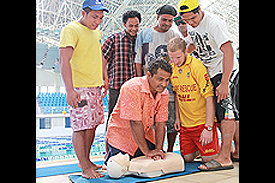
Participants took part in a 50m swim, a 100m
swim and a rescue swim, performed CPR and
applied first aid.
In his keynote address, the Prime Minister and
Minister of Tourism, Hon. Tuilaepa Sailele
Malielegaoi, highlighted the importance of water
safety and said he hoped that the event would
generate interest in careers in Life Saving
among some of the young people who were
participating.
Australian High Commissioner, Dr Stephen
Henningham commented that:
“The skills the participants have learnt will
help save lives. As more and more Samoans
acquire these skills and develop their water
safety awareness, both they and visitors to
Samoa will be able to enjoy Samoa’s pristine
rivers, lagoons and beaches in greater safety.”
David Guest, an Australian Youth Ambassador for
Development (AYAD), who worked with the Samoa
Tourism Authority to organise the competition,
said he was encouraged by the skill level of the
competitors.
“It was great to see competitors put into
practice the life saving skills they have
learned. They have come a long way since the
Surf Life Saving Program started two years ago,”
Mr Guest said.
The overall winner and reigning Champion this
year was Andy Efeso Masoe and runner up was
Peter Tufuga of Coconuts Beach Club and Spa.
Surf Life Saving Samoa runs regional
competitions to increase the profile and
sustainability of water safety awareness and
life saving in Samoa. These activities are
supported by the Australian Sports Outreach
Program, and by the Australian volunteer
programs in Samoa.
Photo 1 - READY…SET: The first heat of
the senior 50m swim about to start.
Photo 2 - GOOD TO GO: Australian Surf
Lifesaver, David Guest prepares participants for
the CPR section of the competition.
|
|
| |
|
|
| |
 |
|
 |
|
|
|
|
|
| |
(Photos:
Office of Congressman Eni F.H. Faleomavaega) |
|
| |
|
|
| |
AMERICA SAMOA: Faleomavaega represents American
Samoa & the Pacific Islander community at CAPAC
Congressional Ceremony for Asian Pacific
American Heritage Month
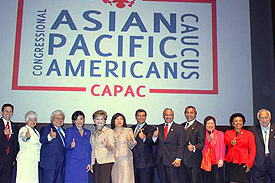
Congressman Faleomavaega, along with fellow
members of the Congressional Asian Pacific
American Caucus (CAPAC) and House Democratic
Leadership, celebrated Asian Pacific American (APA)
Heritage Month and offered remarks to an
audience of over 400 APA community leaders at
the Annual CAPAC Ceremony in the U.S. Capitol
Visitor Center on Wednesday, May 8th, 2013.
With this year’s theme being “A Path Forward on
Comprehensive Immigration Reform,” CAPAC
Chairwoman Judy Chu (CA-32) offered opening
remarks on importance of immigration reform,
followed by remarks by CAPAC’s Immigration
Taskforce co-Chairs, Congressman Honda (CA-23)
and Congressman Faleomavaega.
CAPAC Chair Emeritus Congressman Honda
previously served as Chair of CAPAC while
Congressman Faleomavaega, a member of CAPAC’s
Executive Board, previously served as CAPAC
Vice-Chair.
Congressman Faleomavaega, who is also Ranking
Member of the House Foreign Affairs’
Subcommittee on Asia and the Pacific, opened his
remarks with two proverbs. Faleomavaega shared
the Chinese proverb which says, “Drinking the
water of a well, one should never forget who dug
it,” in reference to those who paved the way for
the Asian-Pacific American voice to be heard in
the recent immigration debate.
The Congressman also shared the Samoan proverb
“E lē falala fua le niu” or “The coconut tree
doesn't sway on its own,” reiterating that
nothing happens without a reason and commending
the many groups and individuals behind the
scenes whose efforts have created significant
progress in national awareness of the needs of
Asian-Pacific Americans.
He also highlighted the increasing significance
of the Asian-Pacific region in U.S. Foreign
Policy and called on leaders in the room to
continue to fight so that Asian-Pacific
Americans are never marginalized or dismissed.
Among other attendees and speakers attended the
ceremony, including Democratic Leader Nancy
Pelosi (CA-12), Democratic Whip Steny Hoyer
(MD-05), Democratic Caucus Chairman Xavier
Becerra (CA-34), and Democratic Caucus Vice
Chair Joseph Crowley (NY-14). Also in attendance
were CAPAC Vice Chair Madeleine Z. Bordallo (GU),
Congressman Bobby Scott (VA-03), Congresswoman
Barbara Lee (CA-13), Congressman Al Green
(TX-09), Congressman Ami Bera (CA-07),
Congresswoman Colleen Hanabusa (HI-01),
Congressman Scott Peters (CA-52), and Senator
Brian Schatz (HI), as well as Congressional
Hispanic Caucus Chairman Ruben Hinojosa (TX-15).
The ceremony also featured a keynote speech
offered by Jose Antonio Vargas, an immigration
activist, filmmaker, journalist, and
undocumented immigrant.
Founded in 1994, CAPAC is comprised of Members
of Congress who have a strong dedication to
promoting the well-being of the Asian-Pacific
American community. Several of the members are
of Asian American or Pacific Islander descent or
represent districts with large populations of
Asian-Pacific Americans.
“I thank President Barack Obama, CAPAC
colleagues, and Democratic leadership in
Congress for their efforts on behalf of
Asian-Pacific Americans across the United
States, and I also thank our and Pacific
Islander leaders who took part in our APA
Heritage Month events in the Nation’s Capital,”
Congressman Faleomavaega stated.
“The beauty of Asian Pacific American Heritage
Month is that no other community in the United
States more accurately represents America’s
diversity than the more than 18 million
Americans who make up the APA community.”
“Because we are a community of immigrants, no
matter what generation, our story is such an
integral part of the greater American story. And
as CAPAC’s Immigration co-Chair, along with my
good friend Congressman Mike Honda, I am pleased
to know that our voice is being heard. The
Senate bill introduced just last month is the
first of many steps that we must take to address
the failures of our current immigration system
for all who hope to also take part in the
American story”.
“While there is more work ahead, we commend the
bi-partisan effort to bring one of the most
progressive and comprehensive reforms to our
immigration system. As we move ahead as a
community, I look forward to working with my
colleagues in Congress to ensure momentum on
this hallmark reform effort.”
“In closing, I once again thank all those who
came before us, our community leaders and
advocates, and especially our APAs serving
throughout the world in the U.S. Armed Forces. I
wish everyone much enjoyment in their
festivities as we celebrate Asian-Pacific
Heritage Month in the spirit of unity,”
Congressman Faleomavaega concluded.
Photo 1 - Members of the Congressional
Asian Pacific American Caucus at the
Congressional Ceremony for the 2013 Asian
Pacific Heritage Month.
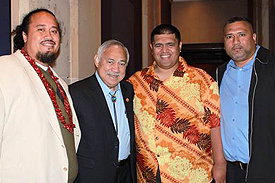
Photo 2 - (L to R) Sefa Aina-White House
Advisory Commission on APIA, Congressman
Faleomavaega, James Letoa- Office of Samoan
Affairs (Sacramento), & Hugo Stanley- TOA
Institute (California), at the Congressional
Ceremony for the 2013 Asian Pacific Heritage
Month.
|
|
| |
|
|
| |
 |
|
 |
|
|
|
|
|
| |
(Photos:
FCLC) |
|
| |
|
|
| |
FIJI: Fiji beekeepers have major potential
Source:
FCLC
Press Release
With the members of the Fiji Beekeepers
Association producing the majority of the
country’s honey, the Association's President,
John Lewis, believes there is great potential
for the industry to grow.
Presently there are 10,000 beehives in the
country that produce the honey. Government
agriculture officer Kamal Prasad, who
specializes in bees, reported that there is a
potential for 50,000 hives.
On average each beehive produces 25 kilograms of
honey. At the present retail prices of $17.50
per kilo, honey could generate a gross income of
over 21 million dollars annually if the industry
operates to its full capacity.
Mr. Lewis, whose association accounts for more
than 80% of the 220 tonnes of honey produced
last year in the country (2012 was a slightly
below average production year), said to achieve
its growth potential beekeeper training needs to
be expanded.
“Government has very effective basic beekeeping
training programs. We have worked closely with
Government at selected workshops and the
Association itself holds seminars and assists
with groups of beekeepers, but funding is
limited so much more needs to be done,” he said.
“Contrary to popular belief, beekeeping is not
'easy-money'. Anyone who goes into beekeeping
has a simple way of making money is bound to
fail.
“Successful beekeeping requires commitment and
dedication. Every successful beekeeper takes a
personal interest in keeping his bees alive and
healthy. He seeks to develop his skill by
continual learning and training,” he said, and
added, “there is an old saying, the beekeeper's
job is to look after the bees, it is the bee's
job to make honey'”
Lack of data also hinders growth in the
industry. A beekeeping industry survey is
presently being organized by the Fiji Beekeepers
Association to produce accurate data to assist
countrywide planning and development.
Founded in 1998, the Association has 45 members
but interest in the industry is high, according
to Mr. Lewis, and as many as 100 beekeepers show
up to their regularly scheduled meetings.
The Association is also a founding member of the
Fiji Crop & Livestock Council (FCLC).
LaviniaKaumaitotoya, CEO of FCLC Secretariat,
said that the strength of the Fiji Beekeepers
Association joined by the Council’s other
Associations, and working closely with
Government, will have a major influence on
moving the agriculture sector forward.
The Council is composed of the Pig, Dairy, Beef,
Sheep/Goat, Root Crop, Ginger, Kava, Honey,
Fruit, Salad Vegetables and Coconut
Associations, as well as Food Processors.
The International Trade Centre is facilitating
the development of the Fiji Crop & Livestock
Council (FCLC) Secretariat with funds provided
by the European Union through its Improvement of
Key Services to Agriculture Programme.
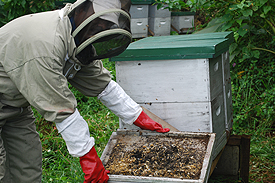
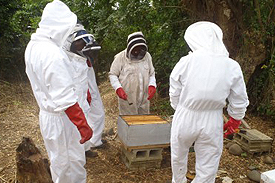
Photo 1 - Understanding the workings of
bees is essential as a beekeeper, Source- Dep.
of Agriculture fiji.
Photo 2 - Training to be a beekeeper
requires commitment.
|
|
| |
|
|
| |
COOK ISLANDS: Cook Islands talks on protecting
natural disaster refugees
Source:
Radio New Zealand International
The first of what will be a series of
consultations aimed at developing a protective
legal framework for people displaced by natural
disasters is underway in the Cook Islands.
The Nansen Initiative intends providing legal
cover for people forced to cross borders by a
natural disaster.
Don Wiseman has more:
“The victims of natural disaster are not
considered refugees and so are not covered by
international law. The concept is being driven
by Swiss and Norwegian academics but the
discussions in Rarotonga also include the Cook
Islands government, the president of Nauru, who
chairs the Association of Small Island States
and the vice president of Kiribati. Regional
agencies such as the Secretariat of the Pacific
Environment Programme and the Pacific Council of
Churches are also involved. The Pacific
consultations on the Nansen Initiative will be
followed by talks in Central America, East
Africa and South and Southeast Asia over the
next year.”
|
|
| |
|
|
| |
AROUND THE WORLD: Joint PIFS-SPC Regional Civil
Society Dialogue on Conflict, Peace and Security
Issues
Source:
Pacific Islands Forum Secretariat Press Release
A regional dialogue for civil society
organisations on conflict, peace, and security
issues was held at the Pacific Islands Forum
Secretariat from 6-10 May 2013.
The dialogue was jointly organised by the Forum
Secretariat and the Secretariat of the Pacific
Community Regional Rights Resource Team (SPC-RRRT),
under a mandate from the Forum Regional Security
Committee (FRSC) in 2009 to strengthen
engagement between the Forum Secretariat and
civil society organisations on conflict, peace,
and security issues.
Forum Secretary General, Tuiloma Neroni Slade,
said he was pleased with the joint partnership
with the Secretariat of the Pacific Community on
such an important mandate, adding that “as both
regional organisations work with civil society
partners, the dialogue provided an opportunity
for different stakeholders, representative of
the array of communities in the Pacific, to
share experiences and discuss mutual areas of
cooperation around human rights and security
issues.”
Participants at the dialogue were representative
of national, regional, and international
humanitarian and human rights organisations
working on disability, health, education,
humanitarian assistance, gender equality, sexual
orientation and gender identities, youth, good
governance, peace and security, and community
media. Civil society representatives from the
Cook Islands, Fiji, Federated States of
Micronesia, Kiribati, Nauru, Niue, Papua New
Guinea, the Republic of the Marshall Islands,
Samoa, Solomon Islands, Tonga, Tuvalu, and
Vanuatu attended the regional dialogue.
Over the weeklong dialogue, civil society
partners discussed the Pacific Islands Forum
reporting mechanisms and processes, as well as
the benefits of adopting the Human Rights Based
Approach. Rich discussions were also held around
the thematic areas of human rights violations,
full and effective participation and inclusion
of persons with disabilities, gender equality,
sexual and gender based violence, sexual
orientation and gender identity, meaningful
youth engagement and participation,
accessibility of affordable quality education,
economic empowerment, communications and media,
and inclusive and effective engagement with
civil society organisations.
Civil society partners also agreed to an
Outcomes Statement, which, amongst other things,
called for urgent action to address sorcery
related violence and killings in Papua New
Guinea, the effects of climate change, most
notably the severe drought in the Republic of
Marshall Islands, and the imminent challenges of
climate induced migration of Pacific peoples.
Civil society partners also called for
recognition of the diverse national and regional
civil society organisations and called for
increased access to consistent, multi-modal,
accountable, participative, systematic and
meaningful engagement with policy formulation
and decision making mechanisms, including the
Pacific Islands Forum.
Secretary General Slade welcomed the wide range
of matters raised by civil society, and
commended civil society organisations for their
hard work and dedication toward ensuring better
and safer lives for all Pacific peoples.
Secretary Slade also noted that “Although some
of the issues raised may be beyond the mandate
of the FRSC, a fair number of the issues raised
are relevant to the work of the wider
Secretariat, and I reiterate our commitment to
continue to work with civil society on all
common areas of interest.”
|
|
| |
|
|
| |
|
|
|