| |
|
|
| |
 |
|
 |
|
|
|
|
|
| |
(Photo: Auckland Council Media) |
|
| |
|
|
| |
NEW ZEALAND: International pre-launch of south
Auckland poet’s book
Source:
Auckland Council Media Press Release
A special pre-launch of ‘Afakasi Speaks’, the
poetical book debut from poet Grace Taylor will
take place this Saturday 2 November, 6pm at
Fresh Gallery Ōtara.
Part of the Southside Arts Festival’s event
OTARAfest, ‘Afakasi Speaks’, is a collection of
19 poems describing how Afakasi (Samoan term for
‘half-caste’) understands herself and the world
around her.
Auckland Council Manager Arts and Culture Kaye
Glamuzina says that Fresh Gallery Ōtara has
special significance for this event as it was
the first formal venue to provide space for
south Auckland spoken word poetry.
“We are pleased to be able to once again host
Grace Taylor, who made her spoken poetry debut
at the gallery in 2008,” she says.
Taylor says that spoken poets are often
perceived as performers and not artists in their
own right. “I wrote this collection to have as
much impact on the page as it would in
performance, it is my hope that this book
contributes to changing attitudes towards spoken
poetry,” she explains.
The official launch will take place in Hawaii in
December 2013.
For more information please visit
www.southside.org.nz
Editor’s Notes:
The book is published by Ala Press in Hawaii.
The book is funded by Creative New Zealand,
edited by Craig Santos Perez and Brandy Nālani
McDougall with consultancy/mentorship by Dr
Selina Tusitala Marsh.
Features the artwork of Pasifika artists, Reina
Sutton, Jahra Wasasala and Aleyna Martinez.
Grace Taylor:
Is of English/ Samoan ancestry, born and raised
in south Auckland
Grace won the Auckland Readers Writers Festival
Poetry Idol 2008 and was a top five finalist in
2009 and 2010
Her poetry is based around identity, social
issues and exploration around the journey of
being women.
Is the co-founder of the South Auckland Poets
Collective, co-founder of Rising Voices Youth
Poetry Movement and Co-Director of Niu
Navigations
www.niunavigations.com
OTARAfest
http://otarafest.com/events/afakasi-speaks-book-launch-performance/
Afakasi Is Dead - Performance Poem
http://www.youtube.com/watch?v=5JWyKWWgyxY
For media assistance, please contact:
Sharne Parsons, senior media advisor, Auckland
Council
Ph: 021993644
Photo: Afakasi Is Dead - Performance
Poem.
|
|
| |
| |
|
|
| |
 |
|
 |
|
| |
 |
|
 |
|
|
|
|
|
| |
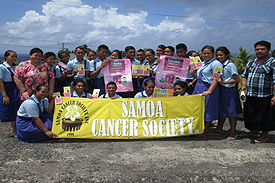
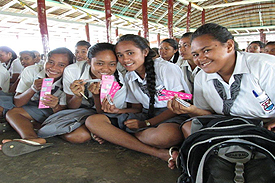
(Photo: Samoa Cancer Society) |
|
| |
|
|
| |
SAMOA: College students to become cancer
informed adults
Source:
Samoa
Cancer Society Press Release
Pinktober month was obviously not limited to
breast cancer issues as the cancer society
continued to roll out its child cancer campaign.
The child cancer campaign launched in July this
year continued through Pinktober with an
emphasis on young people in colleges. An aspect
central to the sustainability of cancer
awareness messages the focus on educating young
people will ensure that they grow up as cancer
informed adults. Senior Community Nurse -
Meaalofa Mataia-Leota said “We are constantly
faced with many myths existing in our country
that is detrimental to Samoans accessing proper
treatment and care for cancer. Almost all of our
cancer sessions carried out had people who had a
firm belief that cancer can be cured through
traditional healers. In these cases when some
early warning signs are seen, people choose to
see traditional healers before seeking a medical
practitioner’s advice resulting in either too
many people presenting to the hospital at the
late stages of the disease and/or early deaths.”
The cancer society focuses on promoting the “St
Siluan” Warning signs of childhood cancer
developed by the South African Children’s Cancer
Study group in 1999 and endorsed internationally
in 2000 by the International Confederation
Childhood Cancer Parent Organisations (ICCCPO)
Evidence show when these signs were used at the
primary health care level by primary health care
workers, they reported an increase in
identification of not only children with cancer,
but children with other chronic illnesses. This
list of warning signs has been found useful in
promoting awareness of cancer in children.
The aim of the campaign was to raise awareness
of childhood cancer and promote early diagnosis,
for children and adolescents to be able to
recognise some of the early warning signs of
cancer amongst them and report to their parents
or teachers to bring to the doctors attention.
Posters in Samoan of early warning signs of
cancer in children & adolescents were given out
to teachers. Students were given information,
such as - Anyone can get cancer! Children and
Adult Cancers are different in that they are
very rare, fast growing, respond well to
treatment, and not linked to environmental
exposures and affects different kinds of cells.
Students were also briefed on the most common
cancers amongst children and adolescents in
Samoa which are leukaemia, brain tumours and
solid tumors.
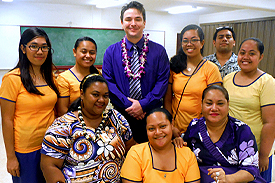
Samoa cancer society nurses were able to deliver
these talks to NUS, Paul VI College, Wesley
College, Aana No1 College and Lepa /Lotofaga
College. Please ring Samoa Cancer Society on
23984 to book in your cancer free session for
your organization, school or church group or
email [email protected] for more
information.
Photo 1 - Lepa & Lotofaga College.
Photo 2 - Wesley College.
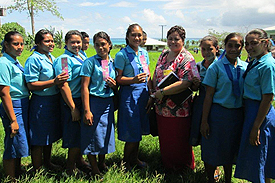
Photo 3 - Senior Community Nurse Meaalofa
Mataia- Leota with Aana No. 1 College students.
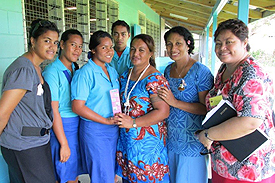
Photo 4 -
Teachers and students Aana No. 1 College with
SCS staff.
|
|
| |
|
|
| |
 |
|
|
|
|
|
|
|
| |
(Photo: J. Kneubuhl) |
|
| |
|
|
| |
AMERICA SAMOA: ASCC/PTK Fall 2013 Induction
The American Samoa Community College (ASCC)
chapter of the prestigious Phi Theta Kappa (PTK)
Honors Society welcomed 18 new members during
its fall 2013 induction ceremony this past
Friday, October 18. With chapters at community
and junior colleges across the United States and
its territories, Phi Theta Kappa recognizes and
encourages excellence in scholarship among
associate degree students. The Greek words Phi
Theta Kappa mean wisdom (Phi), aspiration
(Theta) and purity (Kappa). The society bases
its programs on its four hallmarks: scholarship,
leadership, service and fellowship.
Family and friends, including ASCC President Dr.
Seth Galea’i and Dean of Academic Affairs Dr.
Irene Helsham, packed the ASCC Lecture Hall for
the ceremony, as the PTK celebrated the
scholastic achievements of the College’s “best
and brightest”. The theme for this semester’s
induction was “Today’s Determination Brings
Tomorrow’s Success”, a theme expanded upon by
special guest speaker Mr. Joey Cummings, General
Manager of radio stations KHJ and V103, and
himself a former PTK member. The ceremony also
included a stirring performance of the PTK theme
song by PTK alumni Tony Tuigamala, followed by
the traditional lighting of candles representing
the “flame of knowledge” by the inductees,
followed by their reciting the oath of
allegiance to the PTK.
This semester’s inductees are Destinee Afalava,
Anna Imelda Afoa, Nikolao Alo, Olita Laumua
Hollister-Godinet, Jireh Kruse, Filoisamoa
Langkilde Jr., Tufanua Mase, Ella-Monique Misa,
Mellody Parungo, Togasi’i Peter Peko, Paul
Alaituasivi Saulo Jr., Talimeli F.
Taufete’e,Jessica Tuiletufuga, Anthony
Tuiolosega, Chastity Tuiolosega, Merieni Maryann
Tupuimatagi, Siuila Uele, and Zihao Zeng. They
will join current members Marietta Lafaele
(President), Sia Niupulusu (Vice President),
Maria Magalasin (Secretary), Wittenberg Mariner
(Treasurer), Easther Kim, Peniamina Tai'I, Seong
Hee Kim, Yeseul Kang, Nyrese Pato, Fa'afetai
Ifopo, Moya Beyer, Leli'a Mona Chang, Salani
Leota, Zerahamla Mamea.
Each semester, PTK advisors Toaiva Fiame-Tago,
Evile Feleti, Anthony Felise, Kuki Tuiasosopo,
and Evelyn Fuean review the ASCC Dean’s List and
other relevant data to determine which students
qualify for the membership in the Society. At
ASCC, PTK nominees must have taken at least 12
credits, passed their English 150, English 151
and Math 90 classes, and have earned a
cumulative grade point average of 3.5 or higher.
Qualifying students receive an invitation to
join PTK, and most of those invited readily
accept the offer.
Phi Theta Kappa provides more than $35 million
worth of scholarships annually to student
members nationwide. Each member is automatically
nominated for inclusion in the prestigious
National Dean’s List, and is also enrolled in
the PTK Transfer Database, which links senior
institutions across the nation offering
scholarships to PTK members. For more
information on the Phi Theta Kappa Honors
society, visit their webpage at www.ptk.org.
Photo: Joey Cummings (center, standing),
General Manager of radio stations KHJ and V-103,
visits with advisors and members of the ASCC
chapter of the Phi Theta Kappa Honor Society
following the fall 2013 PTK induction ceremony
this past Friday. Cummings was guest speaker at
the ceremony, during which 18 new members were
inducted into the PTK.
|
|
| |
|
|
| |
FIJI: Pools Drawn For Coastal Great Eight Sevens
Source:
Fiji's Coral Coast Sevens Press Release
An increased number of 32 teams will contest the
Coastal Great Eight Sevens in Sigatoka this
weekend.
Westfield Barbarians, Daveta, Wardens and Army
are among the favoured teams in the Coastal
Great Eight which starts on Friday 1 November
with eight pools of four.
The top two teams from each pool return on
Saturday 2 November when the action becomes
sudden-death as only the winners of the first
eight matches progress to the Bayleys Fiji Coral
Coast Sevens on November 14-16 also at Lawaqa
Park.
The tournament is the final chance for teams to
be accepted into the Coral Coast Sevens.
"There has been phenomenal interest in this
year's Coastal Great Eight and as a result we
have expanded the tournament to 32 teams
enabling as many teams from around Fiji the
opportunity to play," said Tournament Director
Jay Whyte.
"It is a great endorsement of the Bayleys Fiji
Coral Coast Sevens that so many teams want to be
part of the ‘champion of champions’ and we thank
Coastal Rental Cars for their support of this
year’s qualifier".
Entry is free for the tournament which kicks off
at 9:40 am on Friday.
Meanwhile, tickets for the Bayleys Fiji Coral
Coast Sevens, which is sponsored by Goodman
Fielder Fiji, Total Fiji Ltd, Fiji Airways,
Outrigger on the Lagoon • Fiji, Warwick Fiji
Resort & Spa, The Naviti Resort, Fiji Hideaway
Resort & Spa, Coastal Rental Cars, Shangri-La’s
Fijian Resort & Spa, Fiji Chemicals Diversey,
the Tappoo Group of Companies, Serevi Rugby and
Sigatoka River Safari are now on sale.
Further details are on www.sevenspassion.com.
POOLS FOR THE COASTAL GREAT EIGHT, 1-2 November,
Lawaqa Park
A: Westfield Barbarians, Dritabua, Cuvu
Barbarians, Guardforce
B: Daveta, Lomaiviti Barbarians, Sofitel, Colo
West Warriors
C: Wardens Gold, Mala Young Boys, East Bank
Conua, Tabadamu
D: Army, SS Suva Stallions, Shop 2 Save Kuata,
Wainivula Eels
E: Wardens Green, Coastal Senibiau, Central
Barbarians, New Dawn
F: Covenant, Tovolea, Police, Kula Young Boys
G: Tale Barbarians, Western Wardens, Vulimono
Rugby, Sandhill
H: Ratu Filise, Uluinikau, Nasalo Young Boys,
Crusoes
|
|
| |
|
|
| |
 |
|
|
|
|
|
|
|
| |
(Photo: Google) |
|
| |
|
|
| |
NIUE: Premier of Niue says accommodation
expansion moving slowly
Source:
Radio New Zealand International
The premier of Niue says plans to increase the
accommodation capacity on the island is moving
slowly.
Toke Talagi says he hopes an additional 20 to 30
rooms will be established by June.
Air New Zealand agreed to make an extra trip
each fortnight from April to October, on top of
the existing weekly flight, but there are plans
to operate two weekly flights next year.
Beverley Tse was in Niue recently and spoke to
Premier Talagi during the National Show Day
about New Zealand’s contribution to tourism
developments.
TOKE TALAGI: We’ve got excellent infrastructure.
We’ve got good water, we’ve got good power,
we’ve got good roads, we’ve got good
telecommunications. That has all been achieved
with our funding from New Zealand. That is an
extremely important component of what we’re
trying to do to encourage and develop tourism at
this moment. Without those things and without
reliable services and infrastructure we won’t be
able to tourism that we have up until now. The
other thing is we’re looking at possible a
second service every week next year. Now, that’s
an indication of the fact that tourism is
working and it’s not a fiction or somebody’s
imagination. So I’m really pleased about that.
And we are determined to continue to develop our
tourism, but at the same time we also need o
ensure that we don’t focus just our attention on
tourism because we shouldn’t be singularly
focused on one thing. We should be looking at
other opportunities that we have and the
resources that we have on this island and
developing it so that we can cope with any
problems that may occur, for example with
tourism. So we’re looking at water, fish and
possibly mining and possibly some of the
sovereign assets that we have that we can
develop.
BEVERLEY TSE: Now, I understand you are wanting
to see more accommodation providers. How is that
coming along?
TT: Well, it’s slow. I’d like to have them all
done by next year so we can have this second
service. And that’s hinging on that. We
underwrite Air New Zealand’s services here. Up
until now we’ve never had to pay, and that’s
really a signal that we have managed extremely
well our accommodation and airline services to
the island. So I’m very pleased. We will need a
bill, another 20 or 30 rooms, and we’re hoping
to be able to achieve that by June next year,
when hopefully the second service will start.
BT: I understand you’ve announced there will be
some sort of subsidy to help existing
accommodation providers to expand.
TT: No, there won’t be any subsidies. In fact,
what we’re doing at the present moment for
accommodation developments is creating a
speedier process for making the money available.
But it’s not a subsidy, it’s not a grant. It’ll
be a loan just like any other loans that we
provide for businesses here,with the same
interest rates as they pay to the Development
Bank.
BT: What other challenges does the tourism
industry face, other than accommodation?
TT: Maintaining the standards we need to
maintain and also increasing our population
capacity to cope with the number of tourists
that are coming through.
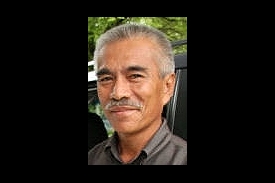
Photo: The premier of Niue, Toke Talagi.
|
|
| |
|
|
| |
AROUND THE WORLD: Palau, Tonga, and Vanuatu Lead
Business Performs in the Pacific in 2012/13
Source:
World
Bank Press Release
Palau, Tonga, and Vanuatu are among the
Pacific region’s top performers when it comes to
implementing business reforms over the last
year, according to the World Bank Group’s annual
report measuring the ease of doing business in
189 economies across the globe.
Doing Business 2014: Understanding Regulations
for Small and Medium-Size Enterprises finds that
Palau introduced legislation that strengthened
the ability of borrowers to access finance by
using movable property secured transaction
systems and made it easier to enforce contracts,
while Vanuatu and Tonga established private
credit bureaus to improve access to finance.
“Creating an enabling business environment and
attractive investment climate are key to
increasing incomes and reducing poverty, so it
is very encouraging to see some of smaller
Pacific island nations introducing effective
reforms over the last 12 months,” said IFC’s
Senior Operations Officer for the Pacific
Jonathon Kirkby. “Overall, the Pacific is still
a relatively hard place to do business, and much
work still needs to be done across the region to
open up business opportunities that create jobs
and change lives.”
IFC is working with a number of Pacific
governments on projects that will help improve
their investment climate and make it easier to
do business. The Papua New Guinea government is
working with IFC and New Zealand Aid to
introduce the country’s first online business
registry. Timor-Leste has recently introduced
the SERVE one-stop-shop where business owners
can obtain a commercial registration
certificate, license, and tax identification
number from a single counter, cutting down the
time required to complete these procedures.
Across the Asia-Pacific region, the Doing
Businessreport finds that since 2005, 24 of 25
economies have made their regulatory environment
more business-friendly. Among the region’s
economies, China made the greatest progress
during that time in improving business
regulation for local entrepreneurs.
Singapore continues to provide the world’s most
business-friendly regulatory environment for
local entrepreneurs, followed by Hong Kong SAR,
China. In the past year, 15 of 25 economies in
East Asia and the Pacific implemented at least
one regulatory reform making it easier to do
business.
Joining Singapore and Hong Kong on the list of
the 10 economies with the most business-friendly
regulations this year are, in this order, New
Zealand, the United States, Denmark, Malaysia,
the Republic of Korea, Georgia, Norway, and the
United Kingdom. This year’s report features a
case study on the Republic of Korea’s electronic
court system for enforcing contracts, Malaysia’s
electronic system for paying taxes, and
Singapore’s single-window system for trading
across borders.
In addition to the global rankings, every year
Doing Business reports the economies that have
improved the most on the indicators since the
previous year. The 10 economies topping that
list this year are (in order of improvement)
Ukraine, Rwanda, the Russian Federation, the
Philippines, Kosovo, Djibouti, Côte d’Ivoire,
Burundi, the former Yugoslav Republic of
Macedonia, and Guatemala. Yet challenges
persist: five of this year’s top
improvers—Burundi, Côte d’Ivoire, Djibouti, the
Philippines, and Ukraine—are still in the bottom
half of the global ranking on the ease of doing
business as measured by the report.
About the Doing Business report series
The joint World Bank and IFC flagship Doing
Business report analyzes regulations that apply
to an economy’s businesses during their life
cycle, including start-up and operations,
trading across borders, paying taxes, and
resolving insolvency. The aggregate ease of
doing business rankings are based on 10
indicators and cover 189 economies. Doing
Business does not measure all aspects of the
business environment that matter to firms and
investors. For example, it does not measure the
quality of fiscal management, other aspects of
macroeconomic stability, the level of skills in
the labor force, or the resilience of financial
systems. Its findings have stimulated policy
debates worldwide and enabled a growing body of
research on how firm-level regulation relates to
economic outcomes across economies. This year’s
report marks the 11th edition of the global
Doing Business report series and covers 189
economies. For more information about the Doing
Business reports, please visit doingbusiness.org
and join us on doingbusiness.org/Facebook.
About the World Bank Group
The World Bank Group is one of the world’s
largest sources of funding and knowledge for
developing countries. It comprises five closely
associated institutions: the International Bank
for Reconstruction and Development (IBRD) and
the International Development Association (IDA),
which together form the World Bank; the
International Finance Corporation (IFC); the
Multilateral Investment Guarantee Agency (MIGA);
and the International Centre for Settlement of
Investment Disputes (ICSID). Each institution
plays a distinct role in the mission to fight
poverty and improve living standards for people
in the developing world. For more information,
please visit www.worldbank.org, www.miga.org,
and www.ifc.org.
|
|
| |
|
|
| |
|
|
|